

 ไทย
ไทย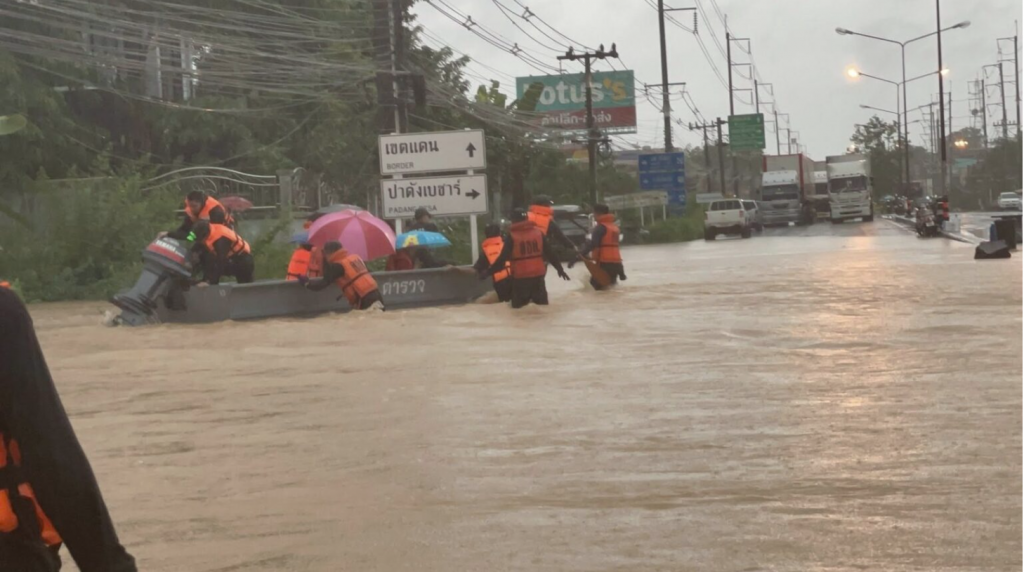
The massive floods in Songkhla and Hat Yai have severely disrupted transportation in lower southern Thailand, impacting almost every route. This has caused delays in cross-border exports to Malaysia and has affected fresh produce businesses, industries, and retailers across the board. Panu Khaopiemjit, Vice President of the Logistics Association, revealed that initial estimates of logistics damage amount to hundreds of millions of baht. He also proposed that the government upgrade water assessment, warning, and rescue coordination systems to prevent future crises.
Mr. Panu Khaopiemjit, Vice President of the Southern Logistics and Transportation Association, gave an interview to Prachachat Business regarding the overall impact, disrupted routes, initial estimated damages, and policy recommendations he would like to suggest to the government following this incident.
This flood has severely impacted almost every route, causing disruptions, disruptions, and risks.
Panu explained that this round of flooding covered a wide area, from Trang and Nakhon Si Thammarat provinces down to Songkhla, and continued into the three southern border provinces, especially Hat Yai, which is a major logistics hub in the region.
“Many routes are impassable and cannot be traveled. Some routes are still passable, but there is a risk to both the vehicles and the goods, which is considered a very high risk in the transportation business.”.
The lower southern region relies almost entirely on road transport. The disuse of numerous major and minor roads is impacting everything from exports to the Malaysian border to the transportation of goods from the south to Bangkok.
The businesses are “trying to deliver the goods,” but there are some points where they simply can’t proceed further.
When asked about immediate solutions while the floodwaters hadn’t receded, Panu reflected that most businesses were trying their best to maintain continuity in transportation.
“With determination and the spirit of logistics professionals, if it’s possible, we’ll try to get there. We braved water levels that were still safe, and we did it,” said the vice president of the association.
However, it must be acknowledged that there are some areas that are truly impassable, even with large vehicles.
In such cases, businesses must communicate to both the originating and receiving customers that this was an “unforeseen circumstance,” and not due to the shipping company’s delays or irresponsibility.
The main routes that have “paralyzed” transportation.
Phanu listed the routes most affected in this round of disruptions, from the Sadao border to Hat Yai.
- Sadao district – High water levels in some areas are affecting trucks coming from the border crossing.
- The traffic light intersection at Thung Lung Market – a high-risk area prone to recurring flooding.
- Khlong Wawa Intersection – A main route connecting Hat Yai city.
- In front of Hat Yai University – on the route to the airport – the water level continues to rise.
- Bang Klam District – The road closure is the most severe impact, as it is a major route connecting Songkhla with Nakhon Si Thammarat and Trang.
These routes are the “bottlenecks” of transportation in the south. When even one route is blocked, the entire system immediately comes to a standstill.
All types of goods were affected, with perishable goods being the hardest hit.
When asked which types of products were most affected, Panu answered clearly, “Almost every type.”
- Perishable goods/fresh food – were the most severely affected because they require speed.
- Industrial goods exported to Penang – many have had to postpone shipments or delay export dates.
- Domestic consumer goods – delays throughout the supply chain.
Although there are no official figures yet, “the damage has occurred across all product categories.”
The estimated damage from the disruption to exports is “hundreds of millions of baht.”
When asked about the estimated value of the damage at this time, Panu stated that although a precise figure cannot yet be determined, it is estimated based on the disruption of routes and the delay in the release of goods from the system.
“In the logistics sector, I think the losses will definitely be in the hundreds of millions, because we’ve slowed down transportation for several days. Many routes are disrupted, trucks can’t run, and a large number of exports to Malaysia have been postponed,” Panu said.
This figure does not include indirect damages, such as missed business opportunities, damaged goods due to delays, or additional costs incurred by entrepreneurs.
When will the logistics system return to normal?
Mr. Panu estimates that the recovery of the logistics system will begin once all routes are passable. As roads reopen, logistics operations will gradually recover by 20-30%, and then increase further as each business operator becomes ready. However, the recovery process doesn’t depend solely on vehicles and warehouses, as many drivers have also been affected as victims of the disaster, needing to care for their families or repair their homes.
“Some families are ready to work quickly, while others are not yet ready and need time. But if the water recedes completely in about a week, I believe the logistics system will be able to resume operations,” said Mr. Panu. Every business has been affected. When asked which types of businesses were most affected, Panu answered straightforwardly.
“Every sector has been affected, from tourism and restaurants to transportation. No one is spared. This event has had a widespread impact.”
Overall, the impact is not limited to exporters or truck owners, but affects the general public and all service businesses in the area.
“If there had been faster and more accurate water level assessments and warning systems, the damage would have been less. Not that there was no damage, but we were better prepared.”
Delays in data transmission leave both businesses and households “unprepared,” resulting in mitigating damage.
Major problem in providing assistance: “The coordination system is not good enough.”
Panu recounted that although many rescue teams had traveled from outside the area, they encountered a serious problem:
I don’t know the exact location where I need help.
There is no central data hub.
The team organization and division of responsibilities are unclear.
“The rescue teams from other provinces are very willing to help, but they don’t know the routes or the locations they need to go to. Coordination isn’t good enough. This is just my personal opinion.”
Phanu pointed out that this problem is not a minor issue, but rather a “structural weakness” that should be addressed before it recurs.
Suggestion to the government: “Plan, prepare, and respond systematically.”
As a representative of logistics entrepreneurs in southern Thailand, Panu had an important suggestion for the government and local authorities:
- A serious analysis of the lessons learned from this event is necessary.
- Develop a risk assessment and early warning system that is faster and more accurate.
- Establish a central coordination center during crises to facilitate communication between rescue agencies, private entities, and the public.
- Plan alternative routes for transport vehicles during floods.
- Prepare manpower and resources to support multi-day road closures.
“We cannot fight natural disasters, but we can plan to cope with them. If the government has a good system in place, the damage will be greatly reduced.”
He emphasized that logistics operators are always ready to work fully if the government provides support in terms of information and better management systems.
Read more at: https://www.prachachat.net/local-economy/news-1926541