

 ไทย
ไทย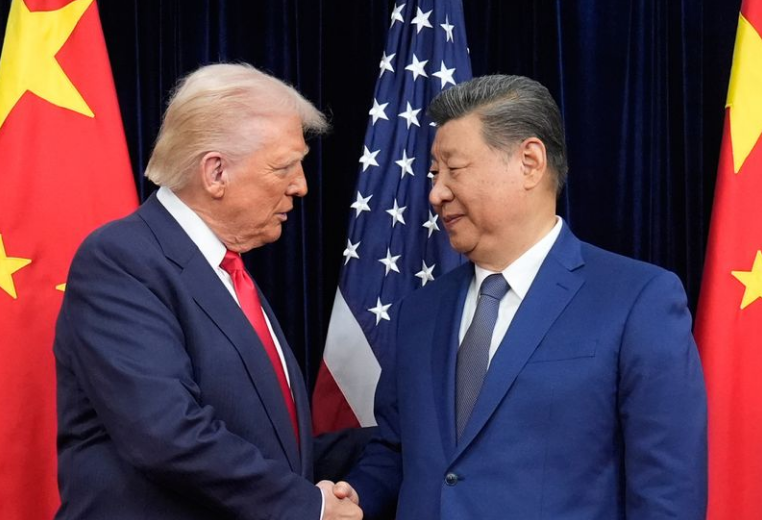
Throughout the year 2025, which is about to end, the world’s loudest leader may be Donald Trump, the President of the United States. Since officially taking office, Trump has used his presidential powers to sign executive orders one after another, creating shockwaves both domestically and internationally. On an international level, Trump not only used “tariff wars” as a tool to rewrite international trade rules, but he also flaunted his power, using the authority and influence of the United States to force peace in various places while simultaneously threatening to wage war in numerous locations around the world.
However, no matter how much hype or threats were made to subdue it, as 2025 draws to a close, it becomes clear that the one who benefited the most over the past year was not Trump, but rather Chinese President Xi Jinping. He demonstrated to the world just how dependent the United States truly is on China, leading many analysts to conclude at the end of the year that the first round of the battle for dominance in the 21st century clearly went to China. Throughout 2025, China will demonstrate its industrial power, with its production of value-added goods accounting for more than a third of global GDP. This gives China enough power to disrupt global supply chains overnight.
For example, in the green technology industry, Chinese companies are a major producer, accounting for 60-80% of the supply chain, including raw materials, components, and finished products such as solar panels, wind turbines, and electric vehicles. Meanwhile, “DeepSeek” demonstrates just how far ahead China is in artificial intelligence (AI), despite the United States’ strenuous efforts to surpass it. Furthermore, Chinese pharmaceutical companies currently have many innovative products in clinical trials, on par with those in the United States, and they can do so even faster. American companies that two decades ago flocked to China to take advantage of its cheap manufacturing processes and vast market now all have research and development facilities in China.
By 2025, Xi Jinping will demonstrate that China’s industrial power is not only a source of wealth but also a source of power. Xi Jinping’s announcement of restrictions on rare earth exports is one example of how China can also use its dependence on other countries as a weapon. Data released by the Australian Institute for Strategic Policy indicates that China currently leads in 66 out of 74 research areas, based on its contribution to major scientific research publications. Interestingly, of these 66 leading areas, China dominates in 22 of them entirely.
What is particularly interesting is that Xi Jinping and China have achieved this level of success partly due to “assistance” from the United States, provided by Trump. On one hand, this was through the declaration of a trade war with arbitrary tariffs; on the other hand, it was through the formulation of domestic policies that ultimately became “suitable” for China. Many economists now openly state that Trump’s decision to launch a new “trade war” against China earlier this year was a mistake. One thing Trump and his allies failed to consider is that the Chinese economy is not based on the same democratic system as the United States. That means the Chinese economy can withstand pain better and more effectively than the American economy. Trump disregarded and ignored the commercial approach of encircling China through close ties with allies, opting instead for an ineffective “tariff war” to isolate China as desired. Similarly, he devalued and attacked domestic science, which only hindered progress. Trump not only persecuted researchers but also cut funding and withheld billions of dollars from institutions he disliked.
Of course, such behavior has deprived important research projects of funding. Not only that, Trump has also shown hostility towards foreign scientists, especially those of Chinese descent, as part of his approach to managing immigrants working in the United States. As a result, talented individuals either choose to leave the United States or decide not to settle there at all. The country that has benefited most from this is China.
In the short term, China appears to have achieved a clear victory, but the long term is not the same. While China may win this year, its dynamism will eventually be constrained and stagnate by political tensions and rigidity. The current state of the Chinese economy reflects this trend. In November, factory gate prices fell 2.2% below a year ago, marking the 38th consecutive month of decline. Resale property prices remain more than 20% below their peak and continue to fall. While the Chinese Communist Party has announced plans to stimulate domestic consumption next year, it will simultaneously continue to support what it considers its “strategic production.” This means that overcapacity will persist.
In a democracy, mistakes lead to change, but it is said that the opposite is true in China: the bigger the mistake, the more cowardly the Communist Party becomes in changing.
Read more at: https://www.prachachat.net/world-news/news-1941392