
 ไทย
ไทย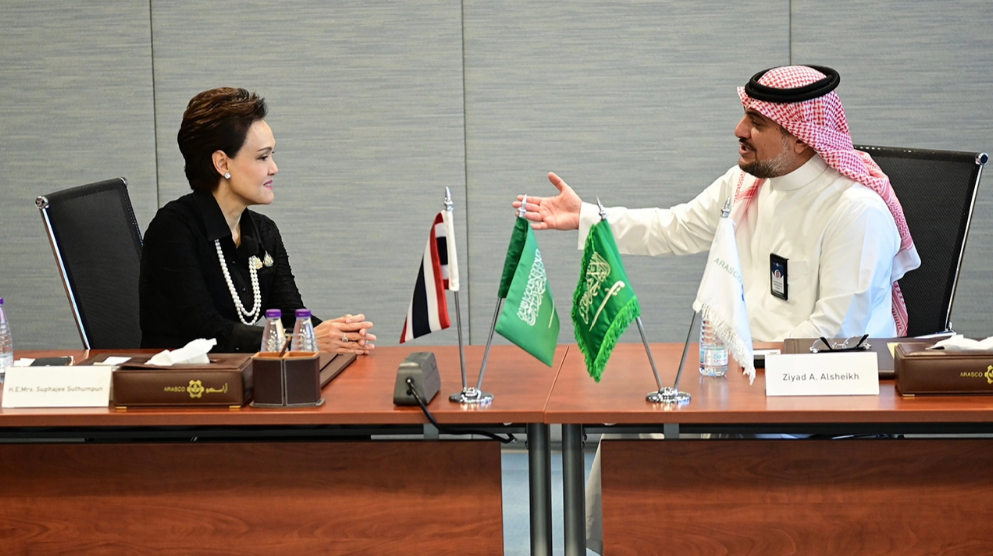
The Ministry of Commerce held discussions with ARASCO, a leader in food security in Saudi Arabia, resulting in an immediate order of 30,000 tons of cassava pellets from Thailand. The goal is to order an additional 100,000 tons next year, while also exploring opportunities to expand cooperation on a full range of Thai agricultural and food products.
On December 4, 2025 (local time), at the Arabian Agricultural Services Company (ARASCO) in Riyadh, Kingdom of Saudi Arabia, Ms. Supajee Suthamphan, Minister of Commerce, revealed that she, along with Ms. Kirida Paochit, Assistant Minister of Commerce, Mr. Wutikrai Leewiraphan, Permanent Secretary of the Ministry of Commerce, Ms. Piyanut Wuttisorn, Advisor to the Minister of Commerce, Ms. Chotima Iamsawadikul, Director-General of the Department of International Trade Negotiations, and other executives from the Ministry of Commerce, met with Mr. Ziyad A. Al-Sheikh, Chief Executive Officer (CEO) of Arabian Agricultural Services Company (ARASCO), one of Saudi Arabia’s most important food security companies, which has been operating for over 40 years, covering the production of animal feed, food products, fertilizers, pesticides, animal medicines and vaccines, as well as comprehensive logistics services.
The Minister of Commerce revealed that Thailand has been in ongoing discussions with ARASCO to support the company’s goal of strengthening food security in Saudi Arabia. Tapioca pellets are one of the key products of this cooperation, with approximately 20,000 tons previously exported on a trial basis and receiving positive feedback.
“ARASCO has four principles in considering importing raw materials: appropriate price, quality standards, timely delivery, and continuity. Thailand meets all these requirements, which is why they decided to increase their order by approximately 30,000 tons today. If everything goes well, they anticipate needing to import an additional 100,000 tons next year,” Ms. Supajee said.
During the discussions, both sides also exchanged views on further cooperation in various agricultural and food products. Thailand proposed additional products such as broken rice, Napier grass for animal feed, as well as fish feed and poultry feed, which ARASCO expressed interest in and is ready to explore further long-term business opportunities with Thailand.
Furthermore, ARASCO has plans to develop its domestic poultry industry to increase self-reliance. Thailand therefore offered its potential as an expert in halal food and food processing. Yesterday, discussions were held with Thai entrepreneurs who export goods to Saudi Arabia, who indicated that Thailand has products ready for export, such as processed chicken, gyoza, sausages, nuggets, and other ready-to-cook and ready-to-eat products. The Saudi Arabian market still has significant growth potential.
The Minister of Commerce further stated that Thailand is well-positioned as a source of high-quality raw materials and a reliable food partner. At the same time, Thailand can leverage the diverse businesses within the ARASCO group to further expand exports of agricultural and food products to the Middle East, including animal feed raw materials, joint ventures in food or livestock, and the development of agricultural innovations or Smart Farming.
In 2024, Saudi Arabia was Thailand’s 19th largest trading partner globally and the 2nd largest in the Middle East. Bilateral trade was valued at US$7,757.03 million, comprising US$2,856.68 million in Thai exports and US$4,900.36 million in Thai imports. Saudi Arabia was Thailand’s 26th largest export market for agricultural and food products (HS codes 01-24), with exports valued at US$247.25 million. During the first 10 months (January-October) of 2025, Thai exports of agricultural and food products to Saudi Arabia were valued at US$219.62 million. Key exported agricultural and food products included processed or preserved fish, rice, animal feed, fruits, nuts, and vegetables.
Read more at: https://www.thairath.co.th/news/governmentpolicy/2899892