

 ไทย
ไทย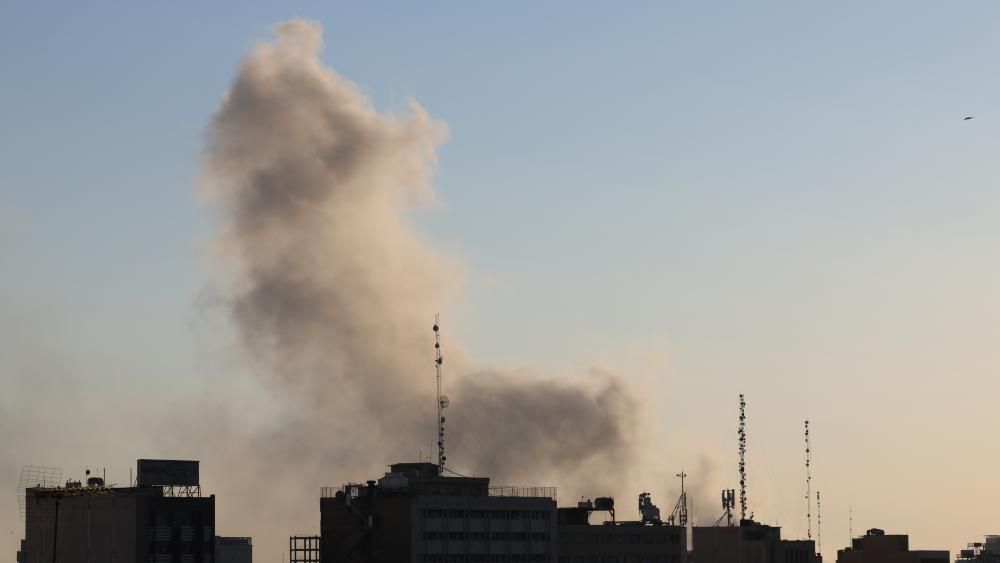
Iranian power brokers are facing what analysts describe as a “test of existence” after the United States and Israel launched an unprecedented military operation aimed at changing the regime. It remains unclear what the path to resolving the problem or reducing the risks will be.
Six months after a 12-day conflict in June, U.S. and Israeli forces conducted a joint operation, attacking government and military targets in Iran. The Israeli military stated that Iran had launched a retaliatory attack against Israel. Meanwhile, there were reports of attacks believed to be Iranian in Dubai, UAE; Doha, Qatar; as well as in Bahrain and Kuwait, areas with U.S. bases or U.S. allies, and other locations in the region.
Why Attack Iran Now
According to Ellie Geranmayeh, senior policy researcher at the European Council on Foreign Relations (ECFR), a think tank that studies research across Europe, the timing and framework of President Donald Trump’s actions leave little ambiguity regarding the political objectives of the operation. “Trump’s announcement of his operational strategy leaves no doubt about his ultimate goal. At least, his goal now is regime change,” she said, adding, “He has left the Iranian leader no choice but to surrender.” In a video released via his Truth Social platform, Trump called on Iranian security forces to surrender or face “sure death.” He also stated that Iranians have “a once-in-a-generation opportunity” to “seize power over your government.”
Ellie described the attack as unprecedented in its scale, stating, “This is an unprecedented U.S. military operation against Iran and has opened the door to chaos in the region, as Iran is now launching a large-scale retaliation as well.” H.A. Hellier, a senior researcher at the Royal United Services Institute (RUSI), a UK security think tank, said the attack was not a “preemptive strike in self-defense.” “This is happening amidst a negotiation process where regional mediators are being unknowingly used as a front for pre-planned operations,” he said, adding that there is no evidence that Iran is planning an attack that would justify a preemptive strike by Israel and the United States. Just hours before the attack, Oman’s foreign minister, who was acting as a mediator in negotiations between the US and Iran, stated that the talks were nearing progress. “A peace deal is within reach, if we allow diplomacy to work as it should,” Badr Albusaidi told CBS on Friday. Following the attack, he wrote on the X platform that he was “extremely disappointed” and stated that “serious and meaningful negotiations have been undermined once again.” “Neither U.S. interests nor the goals of world peace gain anything from this,” he said. “And I pray for the innocent people who are suffering. I implore the United States to stay out of this. This is not your war,” he added.
Tehran Government’s Survival Logic
The clearly stated scope and objectives of this operation have pushed Iran’s ruling class into what experts see as “survival mode.” “This is a life-or-death moment for the leaders of the Islamic Republic,” Geran Mayeh said. “Both their security and ideological positions are preparing for a protracted war with the United States and Israel.” Iranian Foreign Minister Abbas Araghchi stated in a press release that the Iranian government will use “all its defensive and military capabilities under its legitimate right to self-defense” to protect the country’s integrity. Geran Mayeh believes that the Iranian government currently views “escalating the conflict to its maximum level” as a matter of survival rather than a bargaining tool. Hellier agreed on this point, saying that Iran’s swift response “reflects how seriously [the Iranian government] views this threat.” “The speed and coordination indicate that authority was delegated in advance, and it was an immediate, full-force response,” he said.
Geran Mayeh pointed out that the swift response had two objectives: “to demonstrate a firm commitment to expanding any war initiated by the U.S. across the region and to utilize the potential they possess before losing it in this war.” “The Iranian government wants to quickly increase the costs for the U.S. and Israel [hoping to force] both sides to back down before the regime is shaken from within,” she said. Sanam Vakil, director of the Middle East and North Africa program at Chatham House, a UK think tank, agrees with this viewpoint. She stated that while the Islamic Republic is fighting “for survival” and “the only way they can survive… is to rapidly export this war throughout the region, destabilizing many countries and making this war have profound consequences throughout the Middle East.” Geranmayeh also warned that regional allies aligned with Iran, known as the “Axis of Resistance,” might begin mobilizing despite previous losses, driven by a sense of gamble for survival, increasing the risk of multiple conflicts simultaneously.
The longer and more extensive the operation, the more likely it is that regional armed groups will be mobilized, “expanding both the area and duration of the conflict,” wrote Danny Sitrinovich, a senior researcher on Iran at the Institute for National Security Studies (INSS), an Israeli security think tank, in an analysis by the Atlantic Council. He served in Israel’s defense intelligence for 25 years. Sitrinovich argued that the US and Israel chose to attack at this time under the assumption that the Iranian regime was “weak and vulnerable.” Both countries believe that large-scale and intensive joint operations between Israel and the United States could significantly destabilize Iran and potentially trigger internal changes. However, if such an assessment is wrong, the consequences could be very serious. “What are the conditions for victory, and how will such an operation end? These questions are crucial because this operation is unlikely to force the Iranian regime to surrender or reach a future agreement with the United States. And a diplomatic path at this point seems improbable,” he said. “This is an ‘all or nothing’ confrontation, and therefore the level of risk is significantly higher than the previous 12-day military operation,” he added.
How will This Conflict End
Experts view the strategic outcome of this scenario as remaining uncertain and highly risky. “This could be the start of a new protracted war for the United States in the Middle East,” Geran Mayeh warned. She added, “The path from the initial stages of this operation to create shock and fear, to the outcome Trump desires “a regime change” can be long and fraught with obstacles, and there’s a very high chance that everything could collapse quickly.” Hellier agreed, stating, “The conflict is likely to continue for days or weeks, with coordinated escalation on multiple fronts, putting significant pressure on countries in the region to manage the risks to civilian safety and instability.” “Even close U.S. allies who are critical of Iran face the risk of retaliation and potential instability if the Iranian regime collapses in a disorderly manner,” he said. He argued that while many countries might embrace regime change “in principle,” they would still oppose escalating conflict and would strive to de-escalate tensions “even though the path remains unclear.” Geran Mayeh called on the international community to “mobilize resources to mitigate the damage from this war,” urging them to put strong pressure on both the US and Iranian governments to “find a diplomatic solution before being drawn into a bloody conflict.”
Read more at: https://www.bbc.com/thai/articles/ckg2l41z4vgo