

 ไทย
ไทย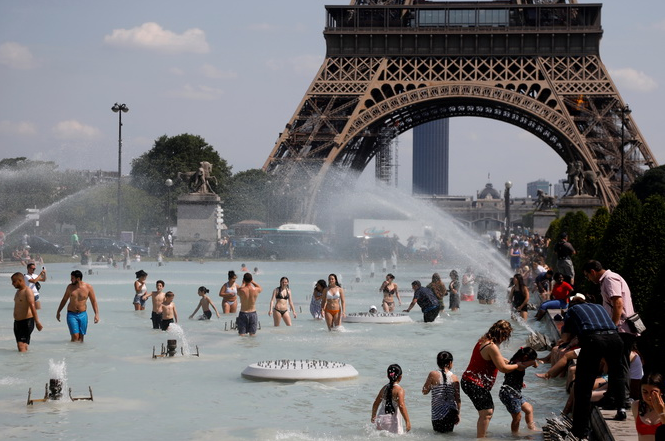
The French government has declared a red alert in 35 areas and banned the sale and consumption of alcohol in public during music festivals amid a severe heatwave covering many regions, with temperatures potentially reaching 41 degrees Celsius in some areas. Many European countries are scrambling to cope with the effects of the extreme heat.
A severe heatwave is sweeping across much of Europe, pushing temperatures close to record highs. In France, the government has declared a “red” heatwave alert, the highest level, in 35 out of 96 regions nationwide, including Paris and the Burgundy region. Temperatures are projected to reach 39-40 degrees Celsius, and in some areas, could reach 41 degrees Celsius before peaking.
Given this situation, Prime Minister Sébastien Lecornu announced proactive measures, banning the sale and consumption of alcoholic beverages in public areas, including the national music festival “Fête de la Musique,” an annual festival held on the summer solstice, the day with the longest daylight hours of the year, which attracts millions of people to the streets. In previous years, up to 2 million people attended the event in Paris alone.
The French Prime Minister’s office stated that the alcohol restriction measures are aimed at stabilizing emergency services and the public health system, allowing medical personnel to focus on caring for vulnerable groups such as the elderly and children. Furthermore, the prolonged heatwave has severely impacted transportation, leading to the cancellation of dozens of train services and the temporary suspension of school classes. Meanwhile, Parisian authorities have opened parks and gardens 24 hours a day to provide residents and tourists with places to cool off in the evenings.
The French meteorological office stated that it remains “uncertain” when this heatwave will end, and that approximately three-quarters of the country’s population is expected to be directly affected. The situation in neighboring European countries is equally difficult. In Germany, a nationwide heat warning has been issued, with temperatures soaring close to 38 degrees Celsius. The German meteorological office warns that the extreme heat and humidity could trigger severe thunderstorms.
In Italy, temperatures soared to 36-37 degrees Celsius, significantly impacting daily life and tourism. Tourists in Rome had to queue in the scorching sun outside the Colosseum, with some seeking refuge from the heat in the cooler underground areas of the Temple of Claudius. Meanwhile, in Bologna, people crowded around the Neptune Fountain, dousing themselves with water to cool down.
In Spain, the Spanish Football Federation decided to close the fan zone in Plaza de Colón, Madrid, where giant screens were set up for watching the World Cup match between Spain and Saudi Arabia, for the safety of fans. This forced fans to disperse and watch the match indoors. In contrast, the players in Atlanta, USA, will be playing in an air-conditioned stadium powered by solar energy.
Scientists explain that climate change, or “global erratic behavior,” is a major factor contributing to the increasing frequency and severity of heatwaves in Europe, increasing the risk of health emergencies and causing economic damage during the summer months. “Heat stress [a condition where the body overheats] is often called a ‘silent killer,’ and homes, workplaces, and schools in Europe are not built to withstand these temperatures,” he said. On Sunday morning, France’s Health Ministry stated that the death toll in the country had risen by approximately 1,000 more than initially anticipated since Wednesday of last week.
The French health ministry stated that the majority of excess deaths occurred among those aged 65 and older, following reports of a 40% increase in deaths at home. “Europe is the fastest warming continent in the world, with temperatures rising twice the global average,” warned Tedros, director-general of the World Health Organization. French central bank governor Emmanuel Moulin warned of the economic impact, stating that while the short-term effects on economic growth might be mixed due to decreased labor productivity being offset by increased energy consumption, in the medium term, such severe heatwaves will inevitably become a negative factor hindering and suppressing the country’s economic activity.
Read more at: https://www.thairath.co.th/news/foreign/2940920