

 ไทย
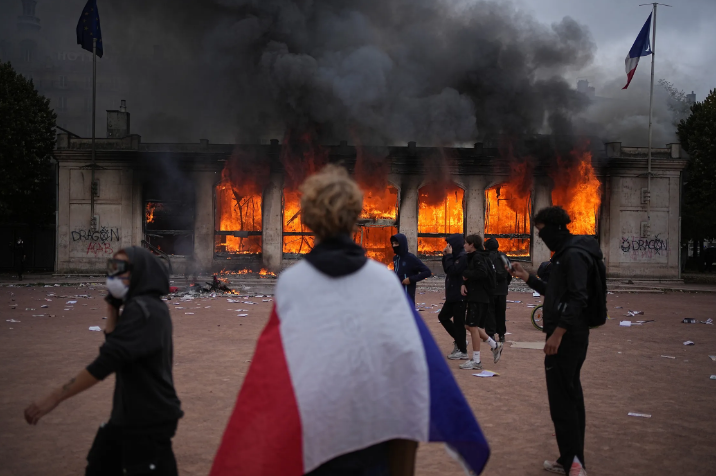
Student protests have spread across the country, exposing cracks in the welfare state, which is facing a severe crisis. The economy is experiencing low growth, public debt is nearing 120% of GDP, government spending is soaring, yet citizens face high living costs and declining public services. France was engulfed in protests from high school students who were fed up with dilapidated classrooms and a teacher shortage. This ignited long-standing discontent across the country, leading to over 500,000 people taking to the streets to protest soaring living costs and poor quality of public services.
Some areas, the situation escalated into clashes with police, looting of shops, and arson of public buildings. Around 1,800 people have been arrested, amidst growing questions about why France, a country renowned for its “welfare state system,” is facing such intense public discontent. Behind this unrest lies not only issues of education and the cost of living, but also a “economic and fiscal crisis” eroding the foundations of France’s welfare state. A country renowned for its pension systems, healthcare, and public services, France is facing a crucial question: where will the state find the funds to maintain these welfare programs amidst low economic growth, soaring public debt, and political conflicts that hinder reform?
-
The Economy is Growing Slowly, but the Government is Spending Enormous Sums of Money.
The problem with the French economy is not that the country has stopped growing, but rather that the “growth is insufficient” to support the accumulated government spending burden. Data from the Organization for Economic Co-operation and Development (OECD) indicates that France will have a budget deficit of 5.1% of its gross domestic product (GDP) in 2025, while public debt is currently soaring to almost 120% of GDP, and the economy has experienced an average growth rate of just 1.4% since 2023.
Meanwhile, France’s government spending stands at approximately 57% of GDP, reflecting the significant role of the large state in allocating economic resources, particularly pensions, healthcare, education, and social welfare. The main problem is that the government consistently spends more than it collects, even outside of emergencies like war or a severe economic crisis. This forces the government to borrow money to cover deficits, accumulating more debt every year. When the economy grows slowly, tax revenue expansion is limited, while welfare spending and interest burdens continue to rise, leaving the government with less fiscal space for investment or addressing public service issues.
-
The Pension System is a Vulnerable Point of the French Welfare State.
One of the biggest pressures on France’s fiscal position is the pension system. As France faces an aging society, with people living longer, the state has to pay pensions for longer periods, while the working-age population, who pay taxes and contribute to the system, are not increasing at the same rate. Previously, President Emmanuel Macron pushed for pension reforms by gradually raising the retirement age from 62 to 64, but faced strong opposition from the public and political parties on both the left and right.
Nobel laureate economist Paul Krugman , in his article “What’s the Matter With France?” published on October 8, 2026, analyzed that a major problem for France is its difficulty in accepting the reality of its retirement system.
Krugman argues that the fiscal burden from a pension system with relatively high benefits forces the government to “cut spending in other areas, especially education,” resulting in a situation where older generations benefit from government subsidies while younger generations bear the brunt of the budget cuts.
This image is reflected in the protests by high school students, who are demanding that the government address the problems of overcrowded classrooms, insufficient teachers, and dilapidated school buildings. In other words, the younger generation is demanding better public services at a time when the government must limit spending to maintain fiscal stability.
-
Heavy Taxes Mean Less Money in People’s Pockets.
Amidst budget cuts and declining quality of public services, French citizens still have to bear the normal Value Added Tax ( VAT ) rate of 20%, the highest personal income tax rate of 45%, and the normal corporate tax rate of 25%. This reflects the irony that one pays high taxes but receives inferior public services. Dissatisfaction with taxes and the cost of living erupted into the “Yellow Vest” protests in 2018, stemming from opposition to fuel tax increases, before expanding into large-scale protests against inequality, reflecting deep-rooted problems in French society.
-
“Overwhelmed by Debt,” the Government has no Money to Quell the Protests.
In the past, when France faced large-scale protests, the government often opted to supplement its budget to alleviate public discontent, whether by increasing aid or expanding public services. However, this situation is different because the government is facing severe fiscal constraints. For decades, low interest rates allowed France to borrow money at relatively low costs, even as public debt continued to rise. However, the COVID-19 pandemic changed the direction of interest rates, making government borrowing more expensive.
Investors are demanding higher yields on French government bonds compared to German bonds, which are seen as a key safe-haven asset in Europe. This reflects concerns about budget deficits, political uncertainty, and the government’s ability to manage debt. The more interest the government has to pay, the less money is left for education, healthcare, and other public services. However, increased borrowing costs do not mean that France is about to default on its debt immediately, but rather reflect the higher costs the government faces in raising funds to implement its policies.
-
Political Divisions Exacerbate the Economic Crisis.
France’s fiscal problems are further complicated by political divisions ahead of the 2027 presidential election. The far right prioritizes immigration control, national identity, and improving welfare conditions, while the left calls for increased investment in public services, wealth redistribution, and protection of workers’ rights. Macron’s centrist political bloc lost its parliamentary majority, making it difficult for the government to push through the budget and reform measures.
The conflict, therefore, lies not only in the question of how France should reduce its debt, but also in the question of who should bear the cost of resolving the problem: taxpayers, pensioners, workers, or the younger generation. Raising taxes by the government could impact purchasing power and investment, but cutting spending risks further protests. Meanwhile, pension reform remains a politically sensitive issue. This uncertainty is making businesses hesitant to invest and further hindering economic recovery.
-
Is France Facing the ‘Limits’ of its Welfare State?
Although France remains one of the world’s major economies and boasts a welfare system that many citizens have long relied on, this crisis is revealing the vulnerabilities of a system facing challenges such as an aging society, slow economic growth, and continuously rising public debt. Ultimately, the French crisis may not only be a test for Macron’s government before the 2027 election, but also raises deeper questions: In a situation where citizens have higher expectations of the state, but the government’s spending capacity is increasingly constrained, how can the welfare system, which once guaranteed life security, fulfill its promises to all generations without leaving a burden for future generations to bear?
Read more at: https://www.bangkokbiznews.com/world/economics/1256924?utm_source=taboola&utm_medium=organic_content_recirculation