

 ไทย
ไทย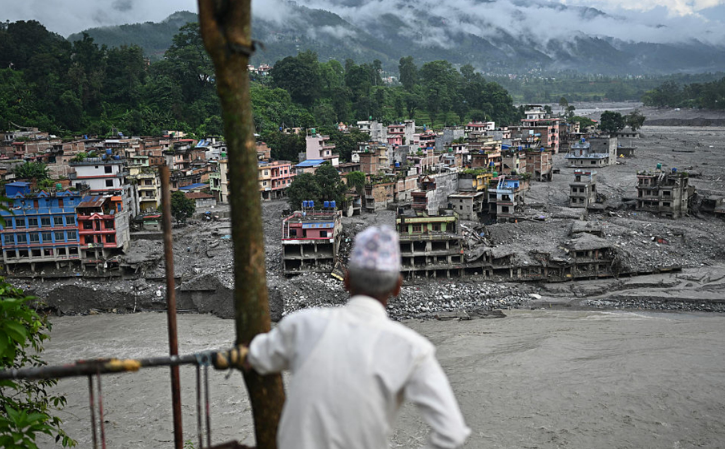
A massive landslide and flash flood on the border between Nepal and Tibet yesterday August 26 2026, caused widespread damage and left hundreds dead or missing.
One of the areas that suffered damage was the Gyirong border crossing, a major border checkpoint for tourists and a key thoroughfare between China and Nepal. In the Jirong County area of Tibet, China’s state television CCTV initially reported this morning that the number of people missing from the mudslide had risen to 558. Previously, Nepalese authorities revealed that around 579 tourists were missing, 466 of whom were foreigners. However, it remains unclear whether there has been any duplication in the figures reported by both sides. Meanwhile, search and rescue operations are racing against time to find the injured and survivors, as Nepalese officials anticipate “massive losses.”
What cause this Landslide
Earlier, Nepal’s Foreign Minister stated that there were reports of an earthquake near the Tibet-Nepal border shortly before the landslide, and suggested that this may have been the cause of the disaster. However, analysis by the United States Geological Survey (USGS) indicates that no earthquake occurred, and that the cause was a glacial collapse and debris flow. Experts are currently trying to piece together the sequence of events. While it is known that climate change is accelerating the melting of glaciers in some areas of the Himalayas, scientists say it is too early to conclude the extent to which this factor played a role in this particular event.
Navin Singh Khadka, an environment reporter for BBC World Service, stated that officials from Nepal’s Meteorology and Hydrology Department told him that some images showed a massive iceberg, possibly part of a glacier, collapsing from the Tibetan side of the mountains, carrying with it a large amount of rock and sediment. Officials stated that friction between the rocks and ice during the fall may have generated a significant amount of water, while the remaining rocks and sediment formed a natural dam across the Lhende River initially, before the dam eventually broke. Some Nepalese scholars based in China have stated that they received similar information from some Chinese experts.
However, China’s Xinhua news agency stated in a post on the X platform that the incident was a mudslide that occurred in Nepal. Previously, there was speculation that it might have been caused by the collapse of a glacial lake, but some glaciology experts have ruled out that possibility. The true cause can only be confirmed with sufficiently clear satellite imagery and verification from multiple sources. Currently, experts say that the monsoon clouds are making this investigation difficult. Massive amounts of mud and debris have flooded towns along Nepal’s northern border, about 64 kilometers north of Kathmandu, the capital. Among the affected areas are popular destinations for mountaineers and pilgrims.
In addition, severe flooding occurred along the Bhote Koshi, Trishuli Ganga, and Narayani rivers. According to the Nepal Tourism Board, there are still missing foreign nationals, including citizens from India, Australia, the Netherlands, the United States, Malaysia, the United Kingdom, and South Africa.
How Did the Government Respond to the Situation
The Nepalese Prime Minister said, “The entire nation is in a state of shock and deep sorrow,” adding that officials would coordinate with China in dealing with the situation. Chinese President Xi Jinping called for a “full-scale” search and rescue operation and pledged to strengthen the situation monitoring and early warning system to prevent potential negative consequences. Meanwhile, in neighboring India, Prime Minister Narendra Modi said his government “is ready to provide Nepal with all possible humanitarian assistance.” Meanwhile, UK Prime Minister Andy Burnham said the British government would do “everything we can” to help British citizens in Nepal. Initially, about 8 tons of relief supplies have been sent to areas affected by the flash floods, while the United States, China, the European Union, and India have pledged to send additional assistance. The United States has pledged $500,000 in aid to provide emergency shelter, clean water, sanitation, and other relief supplies to communities affected by the floods.
Read more at: https://www.bbc.com/thai/articles/cvgylv4v7rno